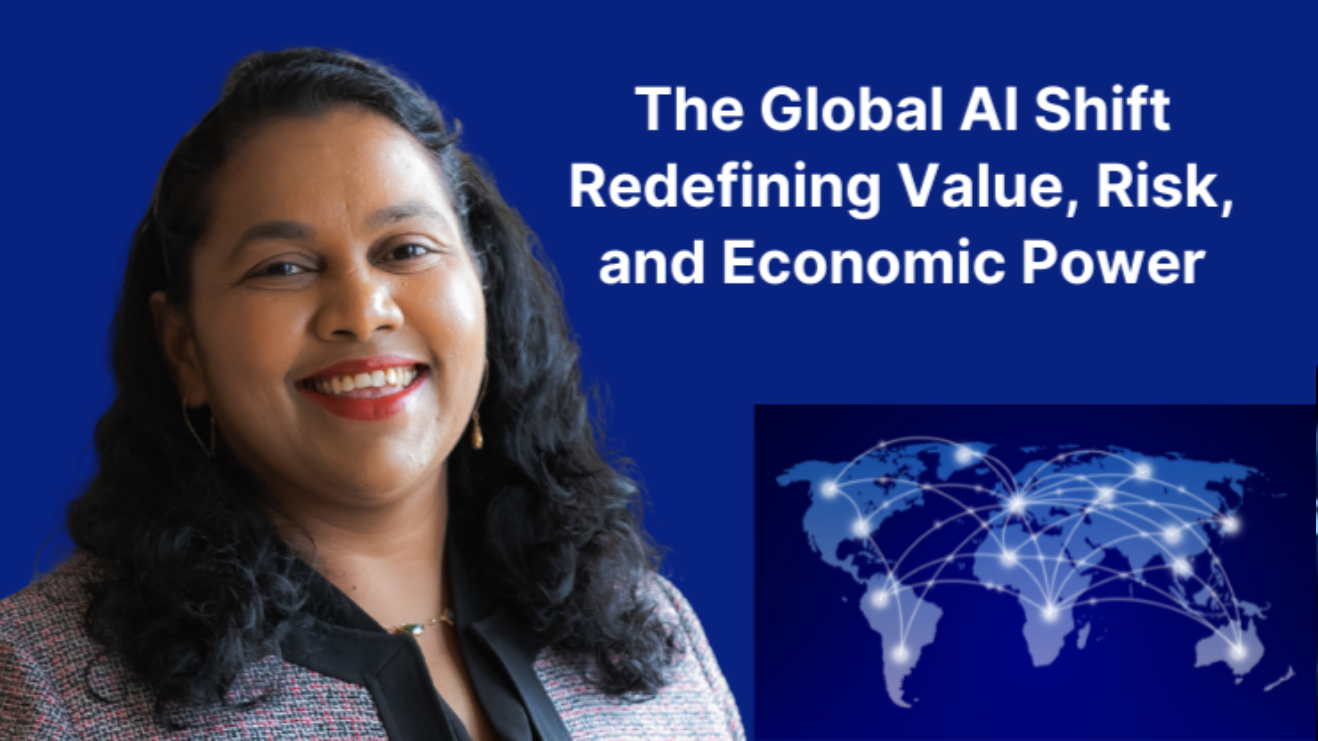
As AI reshapes economies and amplifies systemic risk, the advantage belongs to leaders who pair data intelligence with disciplined oversight.
Before We Dive In
Every economic era is shaped by the tools it trusts most. Today, those tools are AI systems making decisions at speeds that outpace regulation, interpretation, and even basic human debate.
Pricing adjusts in milliseconds. Capital flows without pause. Risk models update before analysts wake up.
This isn’t science fiction. It’s the quiet new infrastructure of the global economy. And while AI expands capability, it also concentrates vulnerability. When everything is optimized, few pause to ask what it’s optimized for, or who benefits.
The leaders who thrive next aren’t the ones who automate fastest. They’re the ones who stay in the loop longest.
When AI Sets the Pace, Markets Lose Their Memory
AI enables markets to behave with unprecedented precision, but also unprecedented synchronicity. Algorithms trained on the same data start to make the same bets, the same assumptions, the same risk moves.
This creates a new kind of systemic fragility:
- Volatility becomes synchronized. When models react alike, shocks travel faster and hit harder.
- Bias becomes scalable. A small assumption in a credit, hiring, or pricing model can cascade into millions of decisions.
- Value becomes narrow. AI prioritizes what’s predictable, often undervaluing creativity, context, and long-term thinking.
- Incentives drift quietly. If the model rewards efficiency, organizations reward conformity and innovation becomes the outlier.
Finance has always had cycles, but AI accelerates them. In an AI-shaped economy, markets think in patterns, not perspectives. And that’s where human judgment becomes the differentiator, not the bottleneck.
How to Lead When AI Moves the Market Before You Can Blink
Thriving in the global AI economy doesn’t require becoming more technical. It requires becoming more systemically aware. Here’s a practical way to stay in control:
- Know the Model Behind the Metric: Every AI output like forecasts, scores, “recommended actions” comes from assumptions. Treat assumptions as assets. Ask: What does this model believe about the world? And does that belief still serve us?
- Measure Resilience, Not Just Return: AI pushes everything toward efficiency. But efficiency without slack creates brittleness. Balance performance metrics with resilience indicators: recovery speed, variance tolerance, counterparty diversity, scenario adaptability.
- Keep Human Judgment in the Loop: AI should accelerate insight, not replace reflection. Build checkpoints where humans review, override, or contextualize model recommendations. Oversight is not friction. It’s governance.
- Track Drift in Real Time: Models don’t fail suddenly. They drift slowly. Monitor anomalies, outliers, and second-order effects. The organizations that catch drift early avoid downstream crises.
AI isn’t replacing leaders. It’s demanding better ones.
A Small Experiment for This Week
Try this AI-Economy Self-Check to map where automation already shapes your decisions:
- Identify three places where AI influences economic choices – pricing, budgets, hiring, credit, forecasts, vendor scoring.
- Write down the default assumption the system makes (e.g., higher engagement = higher relevance; faster response = higher value).
- Ask what happens if that assumption is wrong. Does it cost money? Slow strategy? Distort fairness?
- Add one balancing question to your process: “What would a human expert check that the model skipped?”
- Run that check once this week before acting on an automated output.
The exercise takes five minutes and gives leaders back something AI can’t provide: context.
From Insight to Action
If this perspective resonates, explore The Executive Edge Expeditor: my strategic coaching experience for professionals and leaders who want to strengthen judgment, communication, and influence in an AI-shaped economy.
💼 Learn how to navigate complexity, negotiate value, and lead with clarity as markets evolve.
And for founders, operators, and early-stage teams: join me for the next Startup Growth Playbook, where we break down how tech, finance, and risk shape the systems you’re building.
- 🎥 Next session: Startup Growth Playbook: How Customer Development Fuels Repeatable Growth
- 📅 November 25, 2025 @ 12:00 PM ET
- 🔗 RSVP → https://luma.com/BusinessGrowthNOV25
Together, these sessions build a single continuum: risk awareness → systems thinking → confident decision-making.
🎥 Watch the past sessions:
- Startup Growth Playbook: How to Convert Early Users Into Paying Customers → Oct 1 Replay
- Startup Growth Playbook: Unlocking Angel & Venture Capital for Founders → Oct 15 Replay
- Startup Growth Playbook: Securing Angel Investment – Raise Your First Round → Oct 29 Replay
- Startup Growth Playbook: Turn Your Why Into Investor Confidence → Nov 12 Replay
Closing Thought
AI changes the pace of the economy, but not the purpose of leadership. The organizations that thrive won’t be the ones that trust automation blindly. They’ll be the ones that treat AI as a tool, not a truth.
Because the future of economic power won’t be determined by the smartest models; but by the people who know when to use them, when to question them, and when to lead beyond them.